Written by: Tyler Himes, Senior Brand Manager – James B. Beam Distilling Co.
Key Takeaways
- Jim Beam is distilled primarily at the James B. Beam Distilling Co. in Clermont, Kentucky, with additional high-volume production at the Booker Noe Distillery in Boston, Kentucky.
- The Clermont campus serves as both the historic production site and the main visitor destination on the Kentucky Bourbon Trail, offering tours and tastings year-round.
- Approximately 3.1 million barrels of Jim Beam age across roughly 100 rackhouses in Clermont, Boston, and Frankfort, where temperature variations in the warehouses shape each bourbon’s final character.
- Kentucky’s limestone-filtered water, four-season climate, and deep bourbon infrastructure are the key reasons nearly 95% of the world’s bourbon is made in the state.
Plan your visit to the James B. Beam Distilling Co. and reserve a Beam Made Bourbon Tour & Tasting.
Where Jim Beam’s Clermont Distillery Is Located
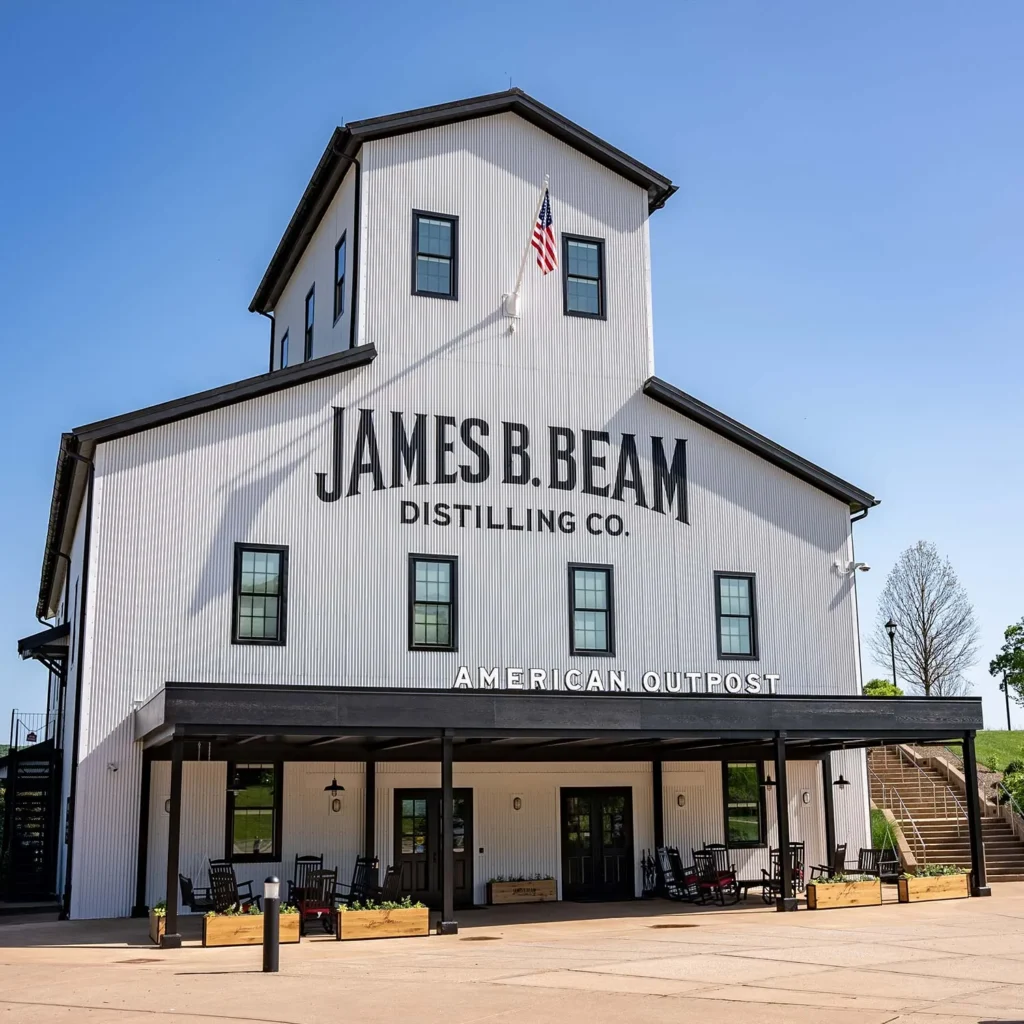
The James B. Beam Distilling Co. campus in Clermont, Kentucky is the historic home of Jim Beam, the working distillery, the visitor destination, and the place where eight generations of one family have made bourbon since Jacob Beam sold his first barrel in 1795. The campus sits on hundreds of acres between Louisville and Bardstown (“the Bourbon Capital of the World”), right off Interstate 65, and is the first stop on the Kentucky Bourbon Trail.
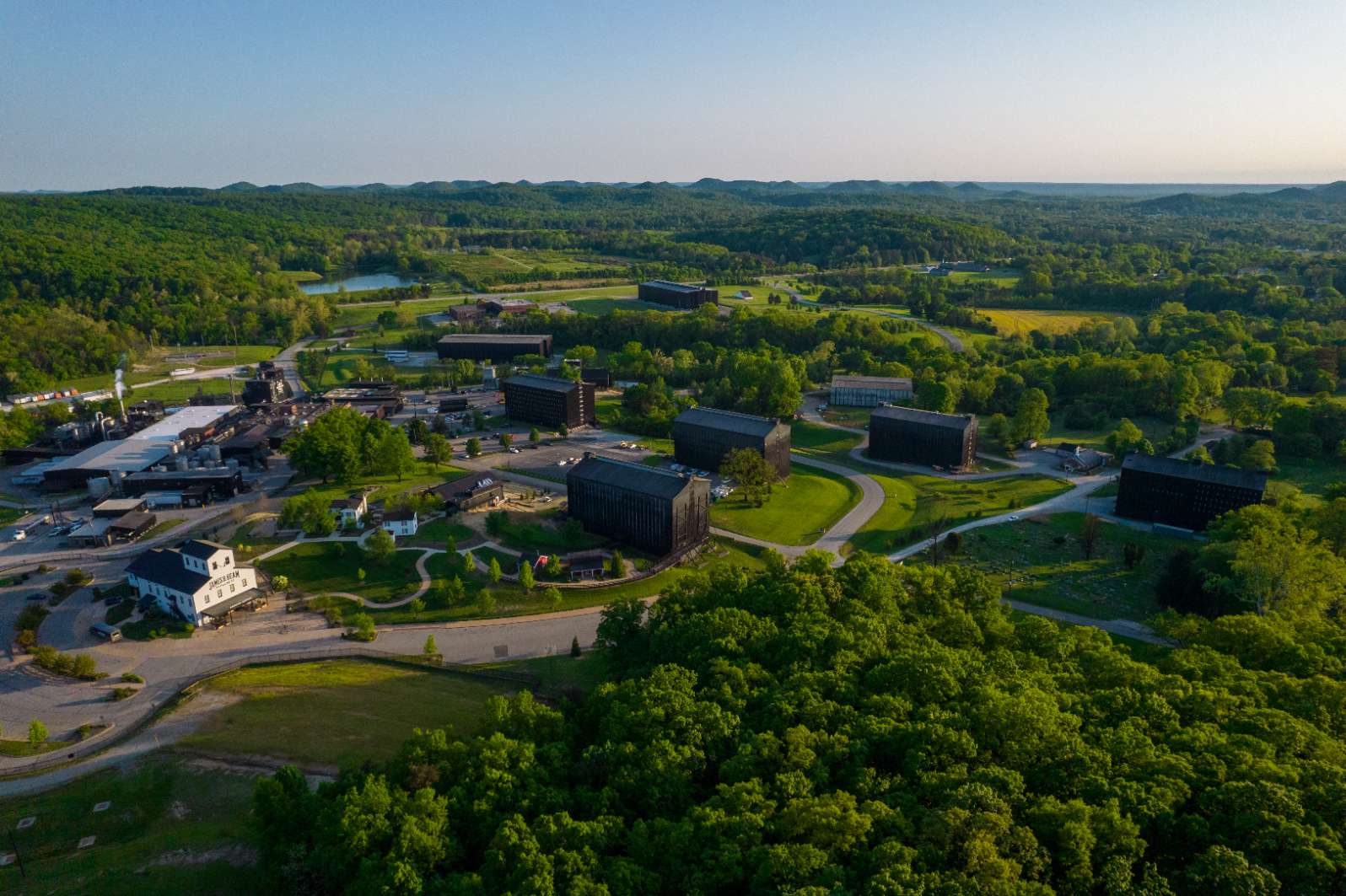
The distillery address is 568 Happy Hollow Rd., Clermont, KY 40110. It is generally open Monday through Sunday, 9:00 a.m.–5:30 p.m. EST (Sunday opens at 9:30 a.m.; Tuesdays are closed in January and February; closed on major holidays). Hours can change seasonally, so checking current hours at beamdistilling.com before visiting is always recommended.
The Clermont campus is a fully operational distillery where bourbon is made and aged, and Jim Beam is sold in more than 150 countries. Visitors can walk the same ground where Jim Beam rebuilt the entire distillery from scratch in 120 days at age 70 after Prohibition, preserving the family’s proprietary yeast strain through all 13 dry years to keep the bourbon’s flavor consistent.
Clermont Vs. Boston: How Jim Beam Production Is Split
The most common source of confusion for searchers is the division of labor between two Kentucky facilities: Clermont and Boston. No competitor content clearly explains this distinction, so here is the definitive breakdown.
Clermont, Kentucky is the historic home campus, the James B. Beam Distilling Co., and the primary distillation source for the full Beam core portfolio. The Clermont facility under DSP-KY-230 is the primary distillation source for Jim Beam White Label, Knob Creek, Booker’s, and Baker’s. It is also the visitor campus where guests take tours, taste bourbon, fill barrels, and meet the Beam family.
Boston, Kentucky is home to the Booker Noe Distillery, a separate high-volume production plant named for the legendary 6th-generation master distiller who created the Small Batch Collection. Beam Suntory’s other Kentucky site, the Booker Noe Distillery in Boston, Kentucky, was not affected by the Clermont distillation pause itself, though it operated on a reduced four-day schedule from late 2025 until returning to full seven-day production in July 2026. Boston handles high-volume distillation and absorbs production load when Clermont’s output is adjusted.
Both facilities produce bourbon under the same family’s oversight, using the same mash bills and the same proprietary yeast strain that has been in continuous cultivation since the end of Prohibition. Fred Noe confirmed that the mash bills and yeast strains going into the restarted Clermont stills are unchanged from before the idle, meaning the character of new barrels tracks consistently with pre-pause production. The table below summarizes how the two facilities differ in role, visitor access, and scale.
Where the Barrels Age: Jim Beam’s Warehouse Footprint
The answer to “where is Jim Beam made” includes more than distillation, because bourbon’s character is built in the barrel. Between 60–70% of a bourbon’s flavor and 100% of its color come from barrel aging, which makes the warehouse footprint as important as the still.
Jim Beam ages roughly 3.1 million barrels across approximately 100 rackhouses in Clermont, Boston, and Frankfort, Kentucky. Suntory Global Spirits operates a 112-rackhouse network across Kentucky, including a 275,000-square-foot, 59,000-barrel rackhouse at 1509 Leestown Road in Frankfort, the largest in the network and Frankfort’s first new rackhouse since 1968.
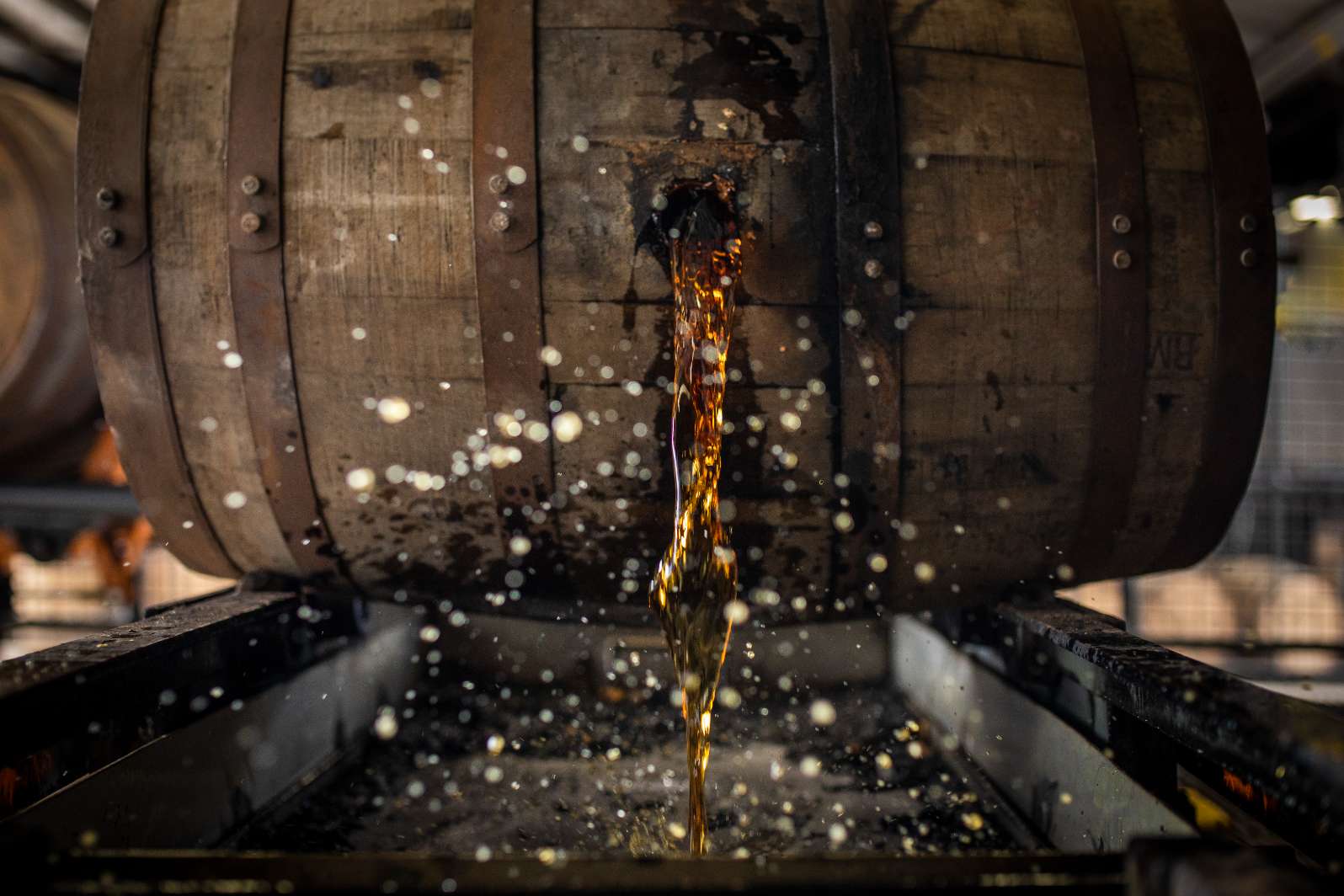
Barrel placement within a rackhouse matters enormously. Top-floor barrels experience higher temperatures and produce darker, more concentrated whiskey, while lower-floor barrels age more slowly and produce lighter, more delicate character. This difference explains why expressions like Booker’s, bottled uncut and unfiltered at barrel proof from selected barrels, taste so different from Jim Beam White Label, even though both start from the same mash bill and yeast strain.
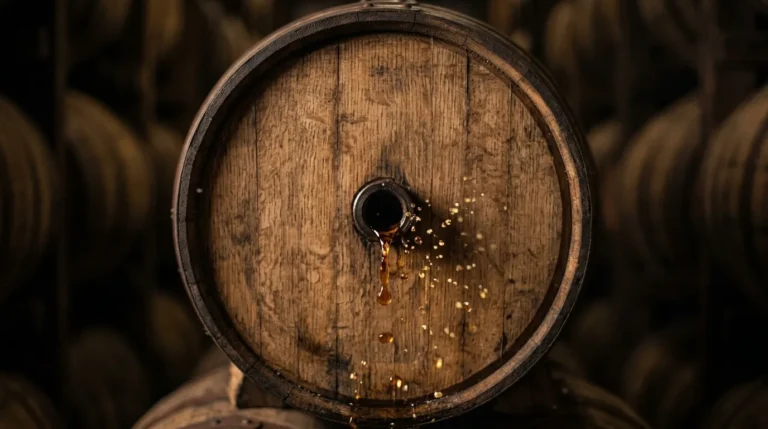
Visitors to the Clermont campus can experience this layer of the process firsthand through the Maturation Matters warehouse experience, an intimate tour inside one of Clermont’s oldest rackhouses where guests hammer open a barrel of Jim Beam Black and thief whiskey straight from the wood with a copper whiskey thief for a barrel-strength tasting. That warehouse experience only exists because of conditions unique to Kentucky, which is why the state became bourbon’s home.
Why Jim Beam Is Made in Kentucky
Three factors converge in Kentucky at a scale no other state matches: water, climate, and infrastructure.
Kentucky’s natural limestone shelf filters water to create iron-free, calcium-rich water that contributes to bourbon flavor, appearance, and fermentation. Iron produces off-flavors during fermentation, while calcium supports yeast health. The Clermont campus draws from a spring-fed lake sitting directly on that limestone shelf.
Kentucky’s wide-ranging four-season climate of cold winters and hot summers drives the barrel maturation cycle that gives bourbon its color and a significant portion of its flavor. Summer heat pushes the spirit deep into the wood, and winter cold contracts it back out. That cycle, repeated year after year, shapes the classic Kentucky bourbon profile.
Kentucky’s advantages are natural, not legal. Federal law requires bourbon to be produced entirely within the United States, meaning fermentation, distillation, barreling, and production must all occur domestically. The full legal definition, administered by the TTB under 27 CFR Part 5, requires:
- Made in the United States
- At least 51% corn in the mash bill
- Distilled at no more than 160 proof
- Entered into new charred oak containers at no more than 125 proof
- Bottled at no less than 80 proof
- Nothing added but water
Kentucky produces approximately 95% of the world’s bourbon supply, even though bourbon is not legally restricted to the state. Bourbon can be made anywhere in the United States, yet Kentucky is where nearly all of it is produced, and the James B. Beam Distilling Co. in Clermont is where the world’s #1 bourbon is made.
Who Owns Jim Beam and Where It Is Made Today
Suntory Global Spirits (formerly Beam Suntory) acquired Jim Beam in 2014. Suntory Global Spirits is a subsidiary of Suntory Holdings Limited of Japan, headquartered in New York City and employing approximately 6,000 people across nearly 30 countries.
Ownership has not moved production. The James B. Beam Distilling Co. states that it distills and ages its American whiskey “without compromise at its family distilleries in Clermont, Kentucky.” Jim Beam is still made in Clermont and Boston, Kentucky, by the same family line that has produced it since 1795.
Jacob Beam sold his first barrel of corn whiskey in Kentucky in 1795, and eight generations later the Beam family still makes bourbon in Clermont, Kentucky, at what is now the James B. Beam Distilling Co. campus. Fred Noe, 7th-generation master distiller, and his son Freddie Noe, 8th-generation master distiller, are on site at Clermont nearly every day, signing bottles, hosting Whiskey Wednesday tastings, and overseeing the liquid that carries their family’s name.
Current Status of the Jim Beam Distillery
The Clermont campus is open to visitors, and distillation has resumed.
Here is the factual timeline. Jim Beam announced it would pause whiskey production for a period at its main Clermont, Kentucky distillery starting January 1, 2026, citing the need to “invest in site enhancements” and rebalance inventories, a deliberate supply-discipline measure. Bottling and warehousing operations at the Jim Beam Clermont site continued through the pause, the visitor center and The Kitchen Table restaurant remained open, and union representatives confirmed no layoffs, with distillery department employees reassigned within the company.
Because of the multi-year lag between distillation and bottling, current Jim Beam shelf availability is unaffected by the 2026 production adjustment. For the most current operational status, beamdistilling.com is the authoritative source.
Visiting the Home of Jim Beam in Clermont, Kentucky
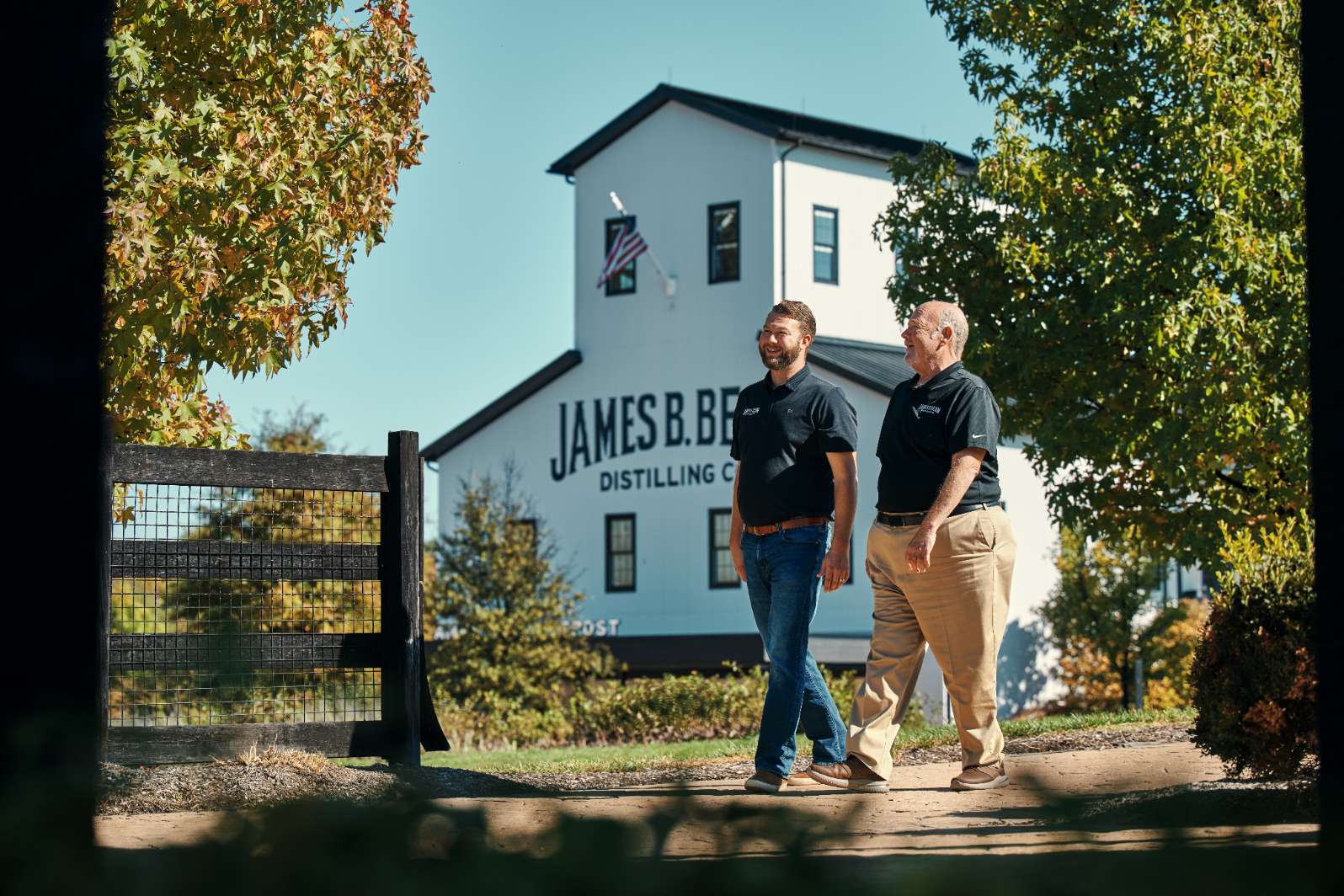
The flagship experience at the James B. Beam Distilling Co. is the Beam Made Bourbon Tour & Tasting, a 75-minute, grain-to-glass walk through the working distillery priced at $30 plus tax and fees, with groups capped at 24 guests. The tour moves in stages, with five bourbons tasted at the moments that explain them. You will try Jim Beam White at Jim Beam’s Cadillac, Jim Beam Black at the mill, Basil Hayden while filling a barrel, Knob Creek at the barrel dump, and a rotating surprise.
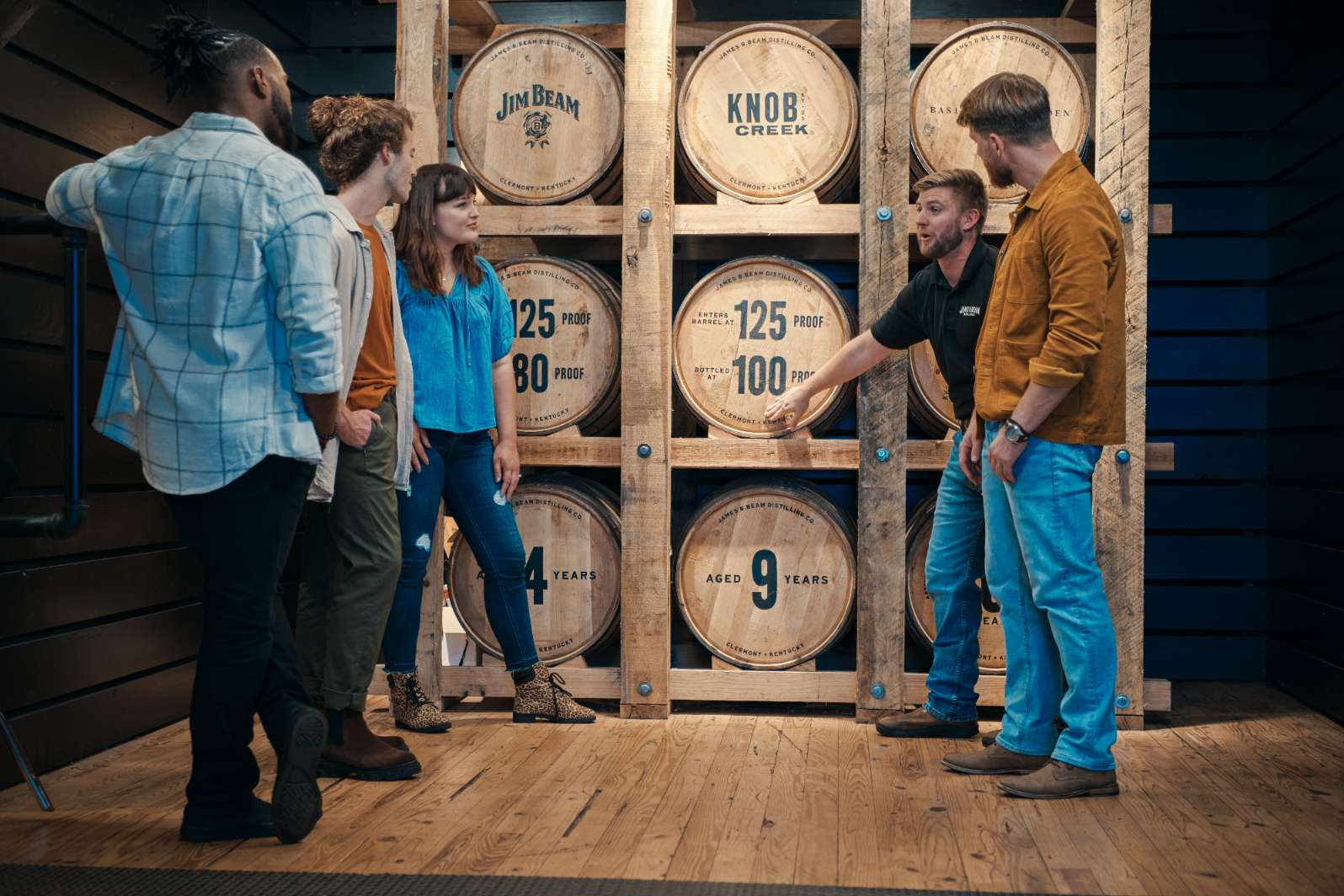
Guests fill a barrel and dump a barrel during the tour. They can also bottle their own Knob Creek on the T-Line by rinsing it, running it down the line, and pressing a thumbprint into the wax seal ($59.99, the same as the gift shop price; engraving is $10).
Beyond the flagship tour, the campus offers the Maturation Matters warehouse experience, the Fred B. Noe Craft Distillery Tour, and Whiskey Wednesday tastings hosted personally by Fred Noe. The Kitchen Table restaurant serves Kentucky-inspired fare, including a sourdough pizza made with the bourbon’s own yeast strain, and the American Outpost gift shop keeps hard-to-find and distillery-exclusive bottles on the shelf with no lottery or timed drops.

Tours should be booked in advance at beamdistilling.com. All tastings are 21+ with valid ID. Active military visit free with valid ID, and veterans receive a discount. Please enjoy responsibly.
Reserve your spot on the Beam Made Bourbon Tour & Tasting at the James B. Beam Distilling Co.
Frequently Asked Questions
Where Is the Jim Beam Factory?
Jim Beam’s production footprint spans three Kentucky locations. The historic James B. Beam Distilling Co. campus in Clermont, Kentucky (568 Happy Hollow Rd., Clermont, KY 40110) is the primary distillation site and the visitor destination. The Booker Noe Distillery in Boston, Kentucky handles high-volume distillation and absorbs production load as needed. As noted earlier, Jim Beam’s aging footprint spans roughly 100 rackhouses across three Kentucky cities. The Clermont campus is the place visitors tour, while Boston and Frankfort operate as production and warehousing sites not open to the general public.
What Country Owns Jim Beam?
Jim Beam is owned by Suntory Global Spirits, a subsidiary of Suntory Holdings Limited of Japan. Suntory acquired the brand in 2014. Ownership has not moved production, and Jim Beam is still made in Clermont and Boston, Kentucky, under the oversight of the Beam family, including 7th-generation master distiller Fred Noe and 8th-generation master distiller Freddie Noe, who are on site at Clermont nearly every day.
Can Bourbon Only Be Made in Kentucky?
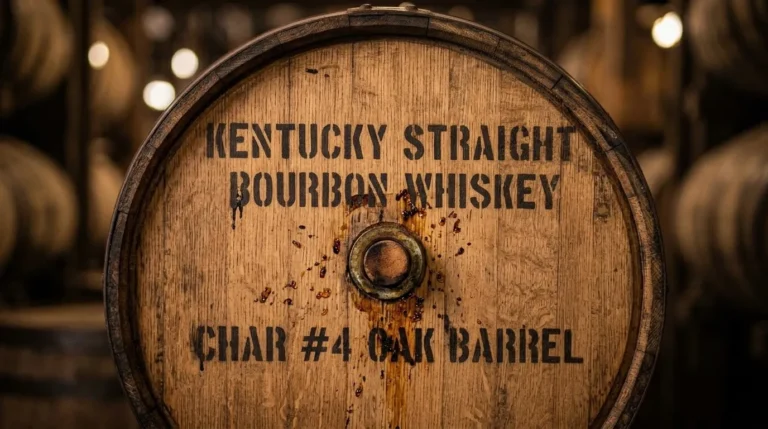
Federal law requires bourbon to be made in the United States, but it does not restrict production to Kentucky specifically. Bourbon can legally be produced in any U.S. state, including Texas, New York, Colorado, Indiana, and others. Kentucky produces approximately 95% of the world’s bourbon supply because of its limestone-filtered water, its dramatic seasonal temperature swings that accelerate barrel maturation, and its deep infrastructure of distillers, cooperages, and warehousing specialists. The phrase “Kentucky Straight Bourbon Whiskey” is a geographically restricted label reserved for bourbon distilled and aged in Kentucky, while standard bourbon carries no geographic requirement beyond being made in the U.S.
Is the Jim Beam Distillery Closed?
The James B. Beam Distilling Co. campus in Clermont, Kentucky paused distillation operations starting January 2026 as a deliberate supply-discipline measure, a calibration of forward production to align with commercial planning. Throughout the pause, the visitor center, The Kitchen Table restaurant, bottling operations, and warehousing all remained open and active. No employees were laid off, and affected workers were reassigned within the company. A phased production restart at Clermont was confirmed in July 2026, with full production targeted for early 2027. The Booker Noe Distillery in Boston, Kentucky continued operating throughout. For current operational status, beamdistilling.com is the best source.
How Far Is Jim Beam from Louisville?
The James B. Beam Distilling Co. in Clermont, Kentucky is approximately 30 minutes south of Louisville, right off Interstate 65. The distillery sits between Louisville and Bardstown, making it a natural first stop on the Kentucky Bourbon Trail for travelers heading south from the city. It is also a straightforward add-on for visitors based in Louisville for SEC football weekends, Derby season, conventions, or any other occasion, because the drive is short and the distillery is easy to reach without navigating downtown traffic.
Conclusion: Jim Beam’s Kentucky Home Is Open
Jim Beam is made in Kentucky, historically distilled primarily at the James B. Beam Distilling Co. in Clermont, with high-volume production at the Booker Noe Distillery in Boston, and aged across rackhouses in Clermont, Boston, and Frankfort (Suntory operates a 112-rackhouse network across Kentucky). The brand is owned by Suntory Holdings of Japan, yet production has remained in Kentucky and under Beam family leadership, with the Beam family still making bourbon in Clermont.
The Clermont campus is open, welcoming visitors, and making bourbon again. The Beam Made Bourbon Tour & Tasting is the most direct way to see it, with 75 minutes grain to glass, five bourbons tasted at the moments that explain them, and hands-on moments such as filling a barrel, dumping a barrel, and bottling your own Knob Creek with a thumbprint in the wax.
All tastings are 21+ with valid ID. Please enjoy responsibly, consistent with Drink Smart®.
This article is promotional content of James B. Beam Distilling Co. Please practice responsible drinking.