Written by: Tyler Himes, Senior Brand Manager – James B. Beam Distilling Co.
Key Takeaways
- Event venues in Louisville use three catering models: in-house exclusive, approved-vendor list, or open policy. The model shapes cost, flexibility, and logistics.
- “Free” rooms usually come with a food-and-beverage minimum that climbs after taxes and service charges, so confirm the true spend in writing.
- Kitchen throughput, not square footage, limits how many plated dinners a venue can serve. Match service style to the kitchen’s hourly capacity.
- Restaurant private rooms share the kitchen with regular diners, while standalone event venues dedicate their culinary team to your group.
- James B. Beam Distilling Co. offers purpose-built event spaces for 22 to 200 guests with full-service dining, distillery experiences, and a dedicated events team south of Louisville.
Book your event at James B. Beam Distilling Co.
The Three Dining Models At Event Venues In Louisville
Every Louisville event venue with dining follows one of three catering models. Knowing the model before you call saves time and prevents contract surprises.
Model 1: In-House Catering (Exclusive). The venue’s own culinary team provides all food and beverage, and outside food and drink are barred. Examples in Louisville include:
- The Brown Hotel, which uses in-house catering across its 17 event spaces (estimated $95–$200 per person).
- Hotel Distil on Whiskey Row, which requires all food and beverage to be provided by the hotel, with packages starting at $140 per person and a $7,000 minimum spend.
- 21c Museum Hotel Louisville, which operates an in-house catering model with food and drink from its on-site restaurant Proof on Main, and event spaces that accommodate 20 to 300 guests.
- Ice House (226 E. Washington St.), which offers over 12,000 sq. ft. of event space with exclusive in-house catering through Crushed Ice Catering.
- Savor at River House (3015 River Rd.), created by Chef John Varanese, which provides 11,000 sq. ft. and an extensive on-site catering menu.
- Churchill Downs, which also operates an exclusive in-house model across more than 50 indoor and outdoor venues, with plated and buffet service, chef-attended stations, and elevated bar packages.
Model 2: Approved-Vendor List. The venue maintains a roster of pre-vetted caterers, and planners choose from that list. The Peterson Dumesnil House in Crescent Hill uses an exclusive in-house catering model with Clementine Catering as its exclusive partner. The Frazier History Museum works with “iconic catering partners” instead of a single in-house team. Approved-vendor lists protect planners from unvetted operators while preserving some menu flexibility.
Model 3: Bring Your Own Caterer (Open Policy). The venue permits any licensed and insured caterer, sometimes for a kitchen or outside-vendor fee. Whitehall House & Gardens (3110 Lexington Rd.) and Hazelnut Farm in Wilsonville operate open vendor policies. Mellwood Art Center, housed in a restored 1904 factory, allows planners to curate their own catering team entirely. Industrial and warehouse venues in Butchertown and the Highlands tend to offer the most outside-vendor flexibility of any Louisville venue category.
The catering model determines everything downstream: who you call, what the minimum spend looks like, and whether your preferred menu is even possible. The next section explains how to decode the minimum spend that comes with each model.
Why “Free” Party Rooms Are Not Free: Food-And-Beverage Minimums Explained
Most “free” party rooms in Louisville carry a hidden cost through food-and-beverage minimums. Restaurants typically waive a separate rental fee in exchange for a contractual spending floor that functions as the real price of the space.
A food-and-beverage minimum is a contractual spending floor, not a per-person rate. The host agrees to spend that amount on the venue’s catered food and drinks in exchange for private use of the space. If the event does not consume enough to hit that floor, the host pays the difference with no leftover food, future credit, or other benefit for the unspent portion.
Several mechanics make minimums more expensive than they appear on paper:
- Taxes and the mandatory service charge alone can add 25%–35% on top of the food-and-beverage total, so a contract with a $10,000 minimum can easily produce a final invoice of $12,500–$13,500 before tips and outside vendors.
- Event proposals often use “++” notation. A $150 per person ++ quote at a venue with a 22% service charge and 8% tax works out to roughly $195 per guest.
- Items that do not count toward the minimum include sales tax, the mandatory service charge, outside vendor costs, and event liability insurance, even when they appear on the same invoice.
- A 22% “service charge” may not reach the servers at all, because some venues keep part or all of it as general revenue.
For context, Riverside EpiCenter in Louisville publishes minimums by room size: Grand Ballroom $1,800–$7,800, Nile Ballroom $1,200–$6,000, and Jordan Ballroom $800–$4,800. Timberyard Brewing Company charges no venue fee but requires a $20 per person food-and-beverage minimum with mandatory pre-ordering. The room is never truly free, because the minimum is the price.
Before signing, confirm in writing the exact minimum and whether a separate room rental fee also applies. Clarify whether pricing uses ++ notation and what each plus represents, how the service charge is distributed between staff and the venue, and whether an attrition allowance exists and how any shortfall penalty is calculated.
Capacity Vs. Kitchen Throughput: Serving 200 Guests Successfully
A room that holds 200 guests for a cocktail reception is different from a room that can serve 200 guests a plated dinner. The key constraint is kitchen throughput, which is the number of finished plates a kitchen can fire per hour, not the square footage of the room.
Kitchen throughput is the most overlooked capacity constraint. A kitchen can only fire a finite number of covers per hour before ticket times balloon. A line that clears 60 entrées an hour cannot absorb 90 covers seated in 45 minutes. For a plated dinner, that ceiling is hard. For a buffet or stations format, the kitchen pre-batches and holds, which changes the math entirely.
When you evaluate any Louisville event venue with dining, ask these questions about service style and kitchen capability:
- How many plated covers per hour can the kitchen fire at peak service?
- Is the kitchen a full commercial kitchen or a warming and finishing kitchen?
- What service styles, such as plated, buffet, stations, or family-style, has the venue executed at your guest count?
- What is the staffing ratio for plated service versus buffet? (Plated service requires roughly 1 server per 20–25 guests, while buffet requires 1 per 40–50 guests.)
A 200-guest plated dinner is a different logistical problem from a 200-guest cocktail reception. Matching service style to kitchen throughput, not just to room capacity, determines whether your event runs smoothly or stalls at the pass.
Restaurant Private Rooms Vs. Standalone Event Venues In Louisville
Louisville planners searching for private dining venues usually see restaurant private rooms listed alongside standalone event venues. These options look similar online but function very differently once guests arrive.
Restaurant private rooms are carved out of an operating restaurant’s floor plan. The kitchen is shared with the main dining room, which means throughput is split between your event and regular service. Menu options are typically limited to the restaurant’s existing offerings. Le Moo’s Blue Moo private room accommodates 80 seated or 120 standing, which works well for a dinner party or rehearsal dinner, but the kitchen serves the main floor at the same time. The Biscuit Lounge similarly operates as a restaurant-first space with private room availability. These venues suit groups of 20–80 where the restaurant’s existing menu fits the occasion.
Standalone event venues are spaces where catering is a separate decision, either through an in-house team dedicated to events, an approved-vendor list, or an open policy. The kitchen or catering operation exists to serve the event, not a concurrent dining room. The Henry Clay (604 S. 3rd St.) offers three main ballrooms, the Grand Ballroom, the Beaux Arts Ballroom, and The Gramercy, accommodating ceremonies up to 150 guests and combined ceremony-plus-reception events up to 300 guests, with rental rates from $5,500 to $14,000 depending on floor and day. Catering is a separate arrangement. Ice House and Savor at River House are standalone venues with dedicated in-house catering operations.
The practical difference is simple. In a restaurant private room, your event competes with the main dining room for kitchen attention. In a standalone venue with a dedicated catering operation, the kitchen exists for your event alone. That distinction matters even more when you look beyond Louisville’s city limits.
The Bourbon-Country Option: Event Venues Near Louisville With Dining At James B. Beam Distilling Co.
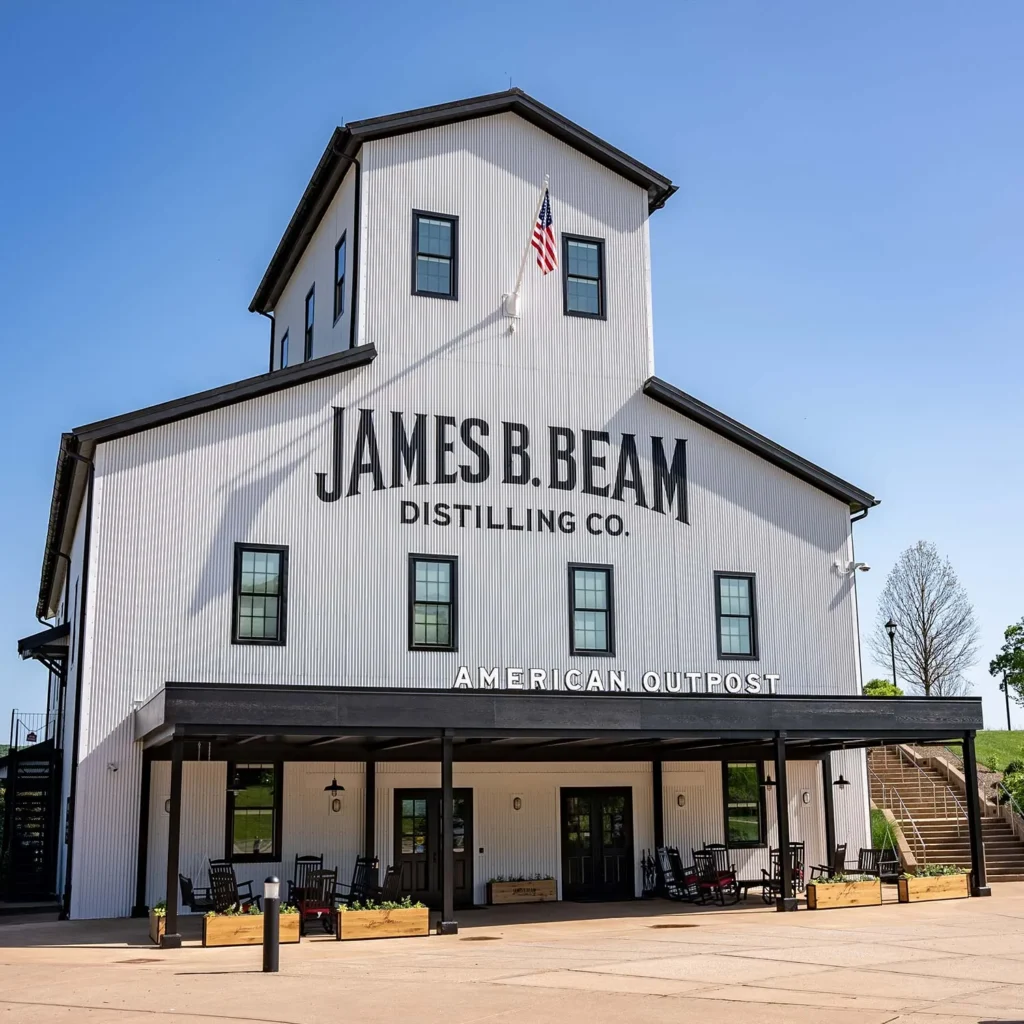
Planners who want a memorable setting with dining built in, and a culinary team that exists specifically to serve events, can look to the James B. Beam Distilling Co. in Clermont, Kentucky. It sits about 30 minutes south of Louisville, right off I-65 between Louisville and Bardstown, and it is a member of the Kentucky Bourbon Trail.
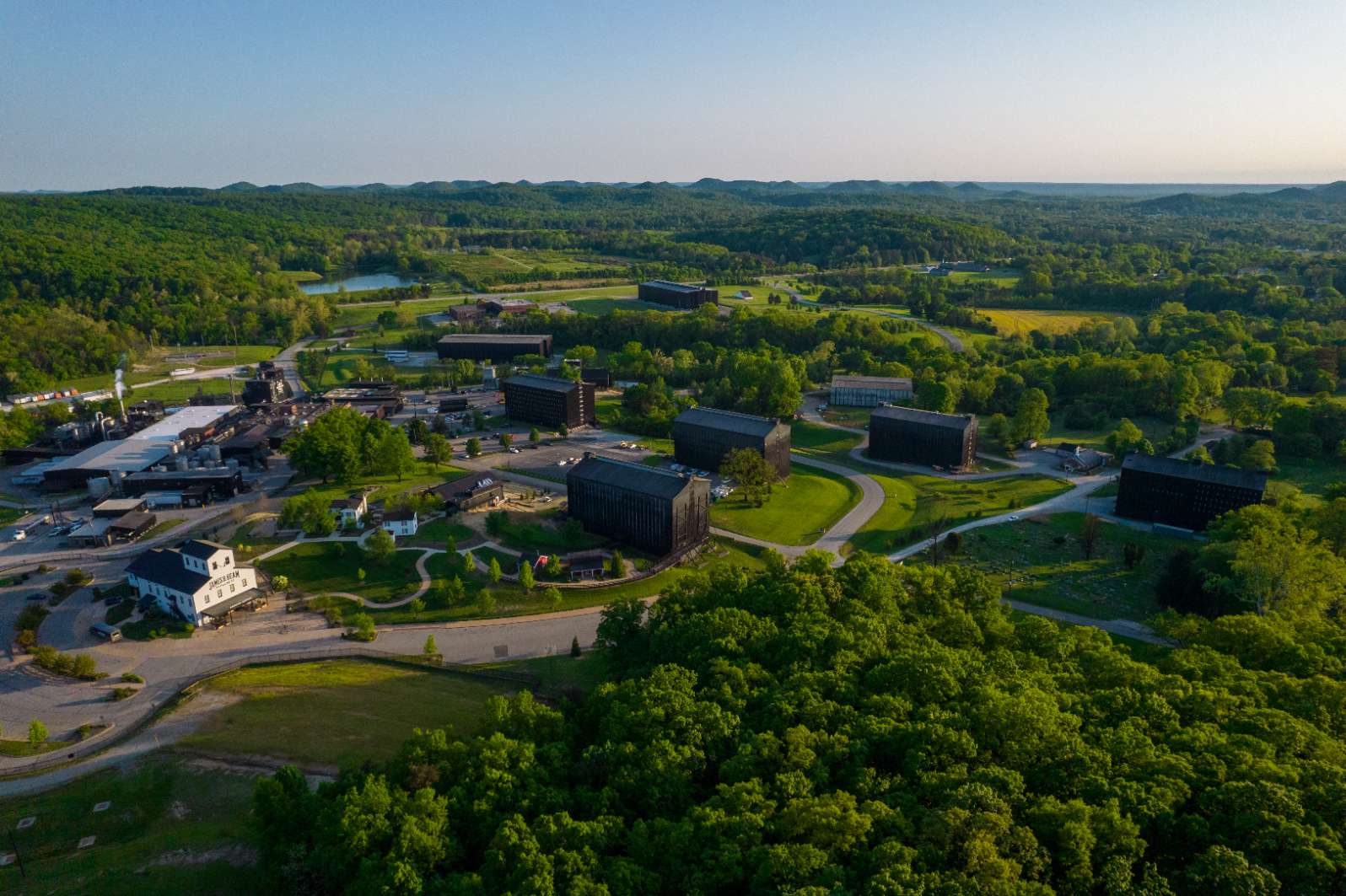
The campus hosts roughly 16 weddings a year plus a full calendar of corporate gatherings and social celebrations, with indoor and outdoor spaces that scale from 22 to 200 guests:
- Baker Beam Home Conference Room up to 22 guests, ideal for executive meetings and small corporate gatherings.
- American Outpost Tasting Room up to 60 guests, purpose-built for whiskey-forward events and private tastings.
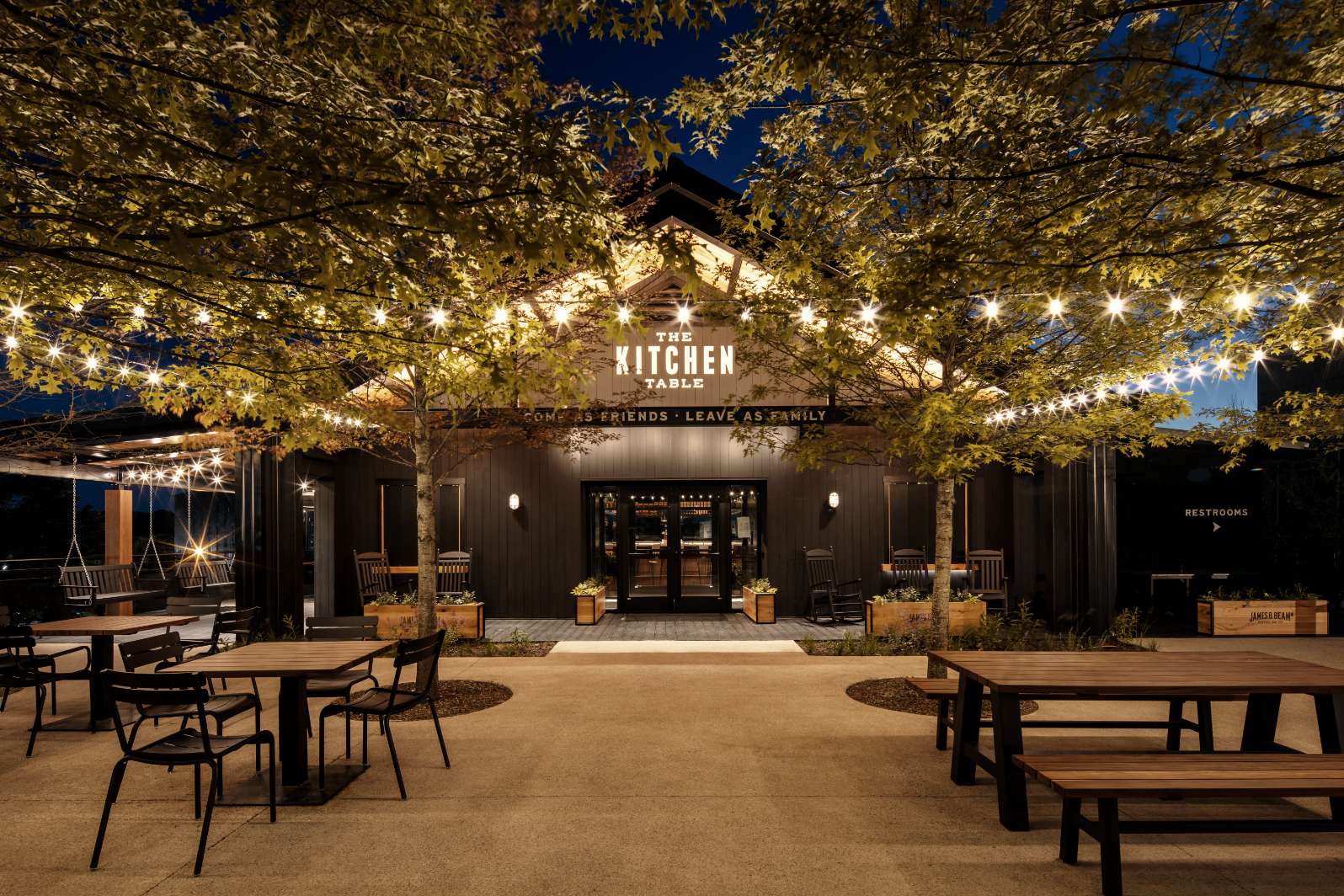
- The Kitchen Table Patio up to 45 guests for outdoor dining.
- The Kitchen Table Courtyard up to 50 guests.
- The Kitchen Table Restaurant up to approximately 120 guests for dinners and receptions.
- Event Lawn up to 150 guests for outdoor receptions and celebrations.
- Cocktail Grove Terrace up to 200 guests, the campus’s largest event space.
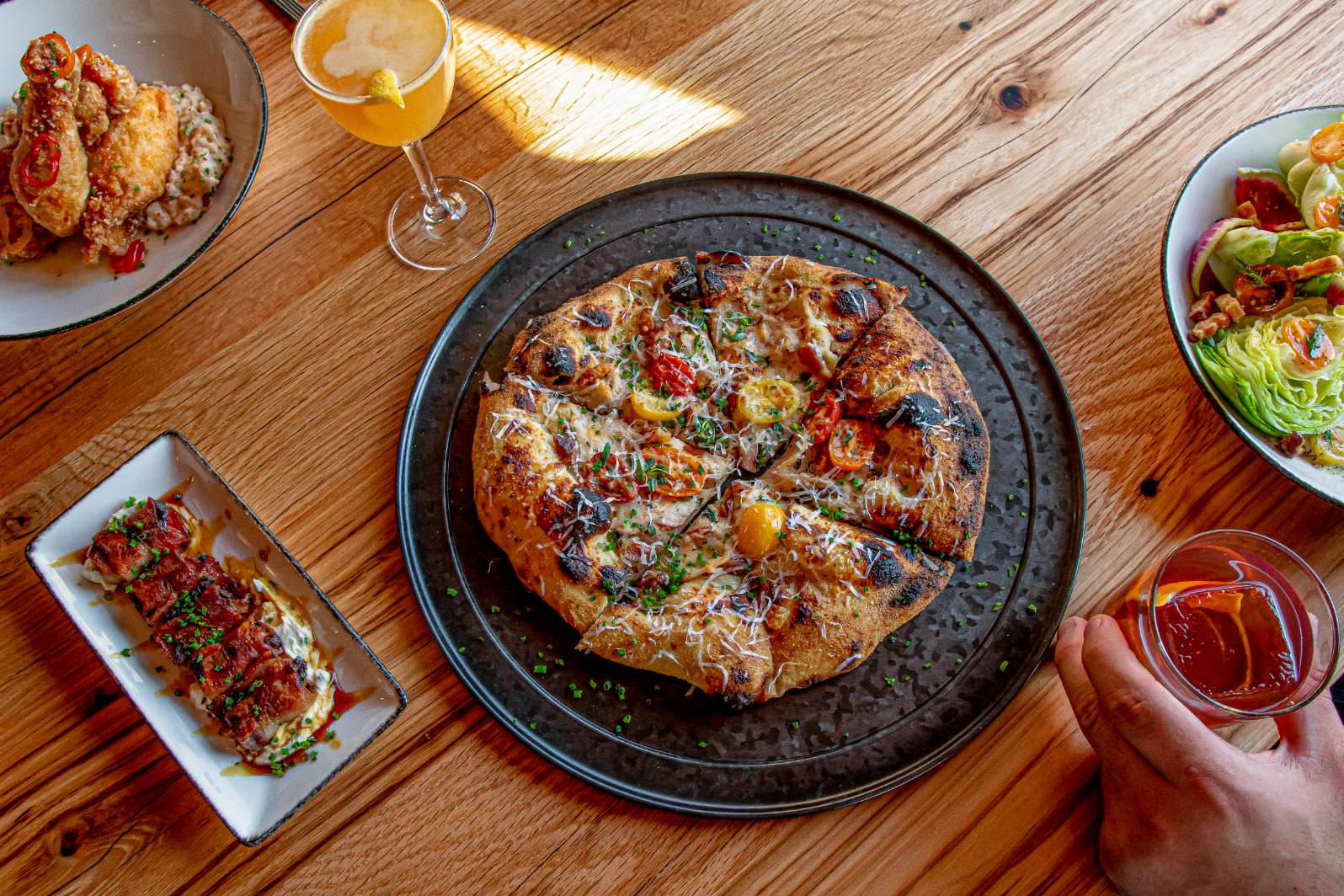
The dining logistics problem is solved before you sign anything. The Kitchen Table is a full-service restaurant and bar with a full-service culinary team. The menu features Kentucky-inspired classics with a Beam twist, including a sourdough pizza made with the same yeast strain used in the bourbon, baked in an Italian pizza oven. The menu changes with the seasons, and the cocktails highlight the family’s whiskeys. You skip the approved-vendor list, the outside-caterer fee, and the risk of a warming kitchen masquerading as a full production kitchen.
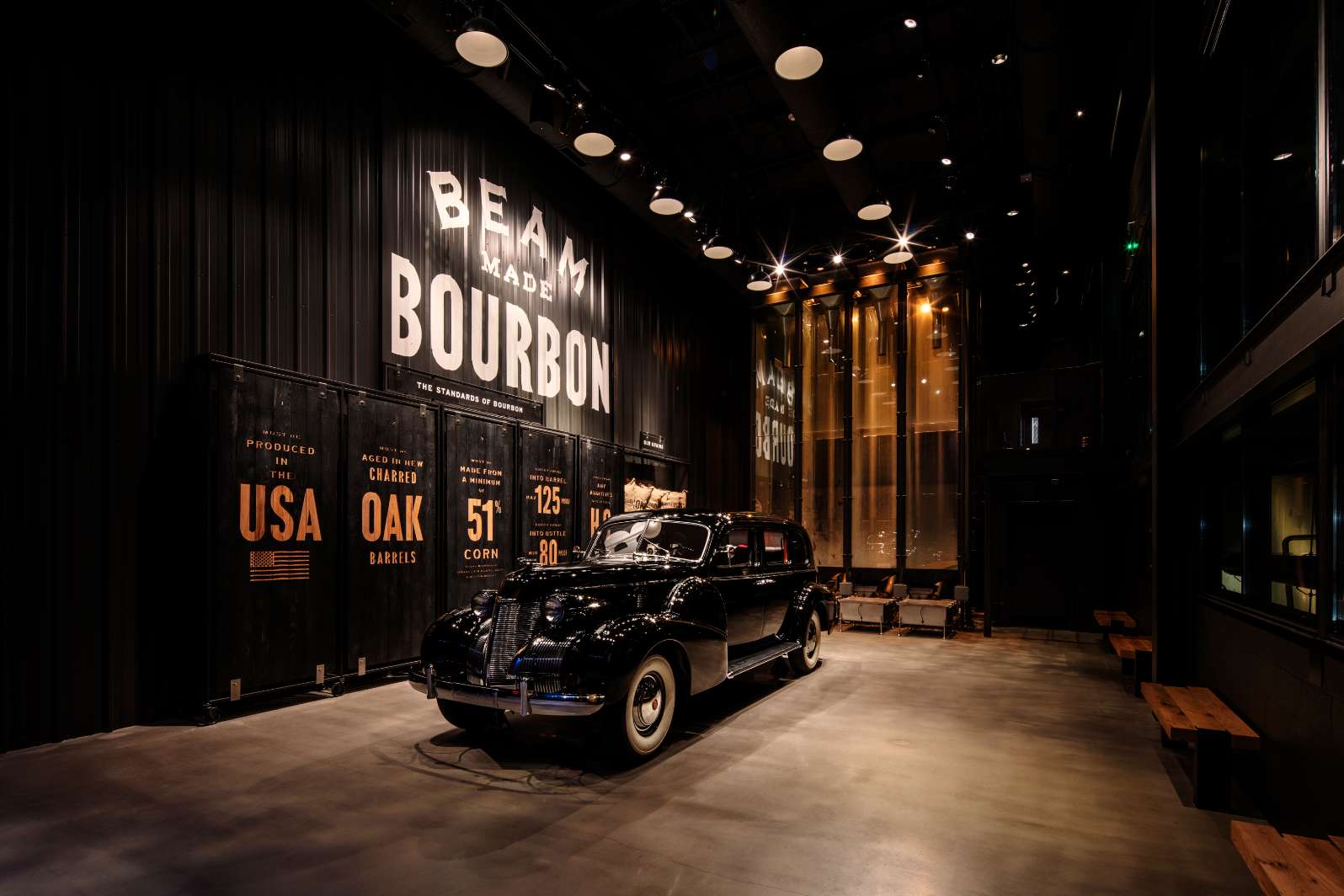
Events can be paired with add-on distillery experiences such as guided tastings, the Beam Made Bourbon Tour, and the Maturation Matters warehouse experience. A dedicated events team handles planning end to end. The setting is the historic home of Jim Beam, the world’s #1 bourbon, where eight generations of one family have made whiskey since 1795, and it holds a 4.7-star rating across more than 1,400 guest reviews.
The I-65 location means guests driving from Louisville pass the distillery on the way to bourbon country. For planners building a full-day experience such as a corporate retreat, a wedding weekend, or a milestone celebration, Beam functions as the destination rather than a compromise on location.
Reserve a private tasting and tour at Beam Distilling Co.
What To Ask Any Louisville Event Venue About Dining Before You Book
Planners avoid surprises when they ask structured questions about dining before signing a contract. Work through these questions in order, because each one builds on the last, from the catering model to the final billing floor.
- What is the catering model, such as exclusive in-house, approved-vendor list, or open policy, and is outside food or alcohol permitted under any circumstances?
- What is the food-and-beverage minimum, does it include or exclude the service charge and tax, and what happens if final spending falls short?
- What are the buyout terms, including any separate room rental fee on top of the minimum, and what does a full venue buyout cost?
- How many plated covers per hour can the kitchen fire, and what service styles such as plated, buffet, stations, or family-style has the venue executed at your guest count?
- What are the staffing ratios for your service style, and are servers and bartenders included in the quoted price or billed separately?
- How does the venue handle dietary accommodations such as gluten-free, vegan, and severe allergens, and are restricted meals plated separately or flagged within a shared service?
- What is the final guaranteed guest count deadline, and what is the billing floor if attendance falls below the guarantee?
- Are outside vendors such as florists, photographers, entertainment, and specialty desserts permitted, and do any of them trigger an outside-vendor fee or require venue approval?
Frequently Asked Questions
What Are Some Small Event Venues In Louisville With Dining?
Several Louisville venues accommodate smaller groups with dining included. Le Moo’s Blue Moo private room seats 80 or holds 120 standing, with the restaurant’s kitchen handling food service. The Biscuit Lounge offers private room availability within a restaurant setting. Collective on Market (711 E. Market St.) fits 40 for a seated dinner with a full kitchen on site. Monnik Beer Co. in Schnitzelburg accommodates up to 70 seated or 120 standing with locally inspired menus and craft beer brewed on-site. PARLOUR Downtown holds up to 125 guests and is noted for vendor flexibility. For groups of 22 or more who want a distinctive setting with full-service dining built in, the James B. Beam Distilling Co. in Clermont offers spaces from the 22-seat Baker Beam Home Conference Room up to the 60-seat American Outpost Tasting Room, all supported by The Kitchen Table’s full-service culinary team.
How Much Does A Louisville Event Venue With Dining Cost?
Costs vary significantly by venue type, service style, and guest count. Louisville catering ranges from roughly $25 per person for basic buffet service to $150 or more per person for premium plated dinners with full bar service. For a 50-guest event, expect $1,250–$2,250 for buffet service or $2,500–$4,500 for plated service with bar packages. A 100-guest wedding in Louisville typically totals $24,800–$37,300 all-in, with venue costs around $5,700 and catering around $4,600. Service charges of 18%–22% and separate gratuity of 15%–20% can add 35%–40% on top of the food-and-beverage subtotal, a figure that does not appear in the headline per-person rate. Hotel Distil’s packages start at $140 per person with a $7,000 minimum. The Henry Clay’s rental rates run $5,500–$14,000 depending on floor and day. The James B. Beam Distilling Co. in Clermont offers event spaces with full-service catering, and the dedicated events team can provide current pricing and availability.
Which Louisville Venues Let You Bring Your Own Caterer?
Open-caterer policies are most common at private estates, art galleries, industrial lofts, and outdoor venues. In the Louisville area, Whitehall House & Gardens (3110 Lexington Rd.) and Hazelnut Farm in Wilsonville both operate open vendor policies. Mellwood Art Center allows planners to curate their own catering team entirely. Progress Park Airstream Resort & Event Venue operates an open vendor policy with no facility fee. Industrial and warehouse-style venues in Butchertown and the Highlands tend to offer the most outside-vendor flexibility. Venues that permit outside caterers typically require those vendors to be licensed and insured, and many charge a kitchen or outside-vendor fee, usually 10%–15% of the food total, for use of the venue’s prep kitchen. Always confirm the policy, the fee, and the insurance requirements in writing before contacting a caterer.
How Far Is Clermont, Kentucky From Louisville?
Clermont, Kentucky is approximately 30 minutes south of Louisville via Interstate 65. The James B. Beam Distilling Co. is located at 568 Happy Hollow Rd., Clermont, KY 40110, directly off I-65 between Louisville and Bardstown, the Bourbon Capital of the World. Guests driving from downtown Louisville pass the distillery on the way into bourbon country, which makes it a natural first stop on the Kentucky Bourbon Trail and an easy drive for event guests coming from Louisville hotels. The campus borders Bernheim Arboretum & Research Forest and sits on hundreds of acres of historic distillery grounds.
Conclusion: Choosing A Louisville Event Venue With Dining
Planners now have a framework for evaluating any Louisville venue with dining: know the catering model, decode the true minimum, match service style to kitchen throughput, and prioritize venues where dining is integrated into the event experience.
For planners who want all four factors handled in one call, the James B. Beam Distilling Co. in Clermont, Kentucky brings them together. The campus offers venues scaling from 22 to 200 guests, a full-service culinary team at The Kitchen Table, a dedicated events team that manages planning end to end, and add-on distillery experiences and guided tastings that turn a dinner into a full day. The result is a setting with eight generations of distilling history behind it and a modern campus designed for guests.
The drive from Louisville is short, and the setting is unmatched.
Plan your event at The Home of the World’s #1 Bourbon
Please enjoy responsibly. 21+ with valid ID.
This article is promotional content of James B. Beam Distilling Co. Please practice responsible drinking.